Custom Search
Showing posts with label Hummingbird. Show all posts

Tuesday, November 20, 2007

Hummingbird

The Anna's Hummingbird (Calypte anna) is a medium-sized hummingbird.

These hummingbirds are glossy green on the back and grey below with green flanks. Their bill is long, straight and slender. The adult male has a glossy red crown and throat and a dark tail. Anna's is the only hummingbird species with a red crown. Females and juveniles have a green crown, a grey throat with some red marking, and a dark tail with white tips.

Their breeding habitat is open wooded or shrubby areas and mountain meadows along the Pacific coast from British Columbia to Arizona. The female builds a large cup nest in a shrub or tree, sometimes in vines or on wires. The nest is round and about 1 1/2 to 2" in diameter. The nest is built of very small twigs, lichen and other mosses, and often lined with downy feathers or animal hair. The nest materials are bound together with spider silk or other sticky materials. They are known to nest early as mid-December and as late as June.

These birds are permanent residents in parts of their range. Some birds may wander north to southern Alaska, south to Mexico or move east from California after nesting season. Some individuals have been banded as far east as Alabama and Florida.

These birds feed on nectar from flowers using a long extendable tongue or catch insects on the wing. While collecting nectar, they also assist in plant pollination. They sometimes eat tree sap.

Unlike most hummingbirds, this bird sings during courtship. They are very territorial.

This bird was named after Anna Massena, Duchess of Rivoli. A hybrid between this species and Allen's Hummingbird has been described as Floresi's Hummingbird, "Selasphorus" floresii (Ridgway, 1909; Taylor, 1909); the hybrid with the Black-chinned Hummingbird was called "Trochilus" violajugulum.

Saturday, November 10, 2007

Female Anna Hummingbird

Hummingbirds are small birds in the family Trochilidae, native only to the Americas. They are known for their ability to hover in mid-air by rapidly flapping their wings, 15–80 times per second (depending on the species). Capable of sustained hovering, the hummingbird has the ability to fly deliberately backwards (this is the only group of birds able to do so or vertically, and to maintain position while drinking nectar or eating tiny arthropods from flower blossoms. They are named for the characteristic hum made by their wings.

The hummingbird is a small bird with a long, thin beak. This elongated beak is one of the defining characteristics of the hummingbird, which, with an extendable, bifurcated tongue, has evolved in order to allow the bird to feed upon nectar deep within flowers. A hummingbird's lower beak also has the unique ability to flex downward to create a wider opening, facilitating the capture of insects in the mouth rather than at the tip of the beak.

Tuesday, October 16, 2007

Broadtail Hummingbird


A hummingbird of subalpine meadows, the Broad-tailed Hummingbird ranges across the south-central Rockies in summer. It possesses a number of physiological and behavioral adaptations to survive cold nights, including the ability to enter torpor, slowing its heart rate and dropping its body temperature.

The Broad-tailed Hummingbird enters torpor, a slowed metabolic state, on cold nights. It maintains a body temperature of about 12.2�C (54� F) when ambient temperatures fall below 10�C (44� F).

In some areas of Broad-tailed Hummingbird breeding habitat, cold air descends into valleys at night, with warmer areas upslope. This phenomenon is called a thermal inversion. The male Broad-tailed Hummingbird, which does not attend the nest, goes upslope at night to conserve heat, reducing the energy costs of thermoregulation by about 15 percent.

* Size: 8-9 cm (3-4 in)
* Wingspan: 13 cm (5 in)
* Weight: 3-4 g (0.11-0.14 ounces)

Small bird; medium-sized hummingbird. Shiny green upperparts. Adult male has red throat. Adult female has white throat speckled with iridescent green or bronze.

Monday, September 17, 2007

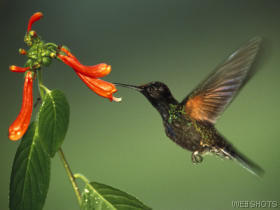
Velvet-Purple Coronet, Ecuador


The success and popularity of our ‘Cock-of-the-Rock tour’, in north-central Ecuador, has prompted us to expand our selection in this bird-rich country. Whilst many birders are familiar with such sites as Mindo, Bellavista and Tandayapa, the chocó and lowland forests of north-western Ecuador are less well known, yet home to many range-restricted and endemic birds.

When the Andes were formed, the Chocó region (wet lowland coastal forests stretching from Ecuador through Colombia and into Panama) was cut off from the Amazon rainforests in the east, leading to a divergent evolutionary path. It is now thought that between one-fifth and a half of all the species found in this area are endemic. In the last 60 years however, over 95% of Ecuador’s Chocó forests have been destroyed; it now has the dubious honour of being the most intensively farmed area in Ecuador, covered mainly with monoculture African palm oil plantations. The Chocó Endemic Bird Area (EBA), as defined by BirdLife International, traverses the length of western Colombia and Ecuador. The EBA, characterized by wet forest and with up to 16,000mm of rain per year, is arguably the wettest place on earth! The Chocó has one of the world’s richest lowland biotas, with exceptional richness and endemism in a wide range of taxa, including over 50 endemic bird species.

This is the area on which this tour focuses; an ideal itinerary for repeat visitors to Ecuador in search of new and exciting birding horizons. The tour is also a chance to support a critically-important self-sustaining ecotourism enterprise run by the region’s poor Afro-Ecuadorian population.

Purple-Throated Mountain-Gem, Costa Rica


The Purple-throated Mountain-gem (Lampornis calolaemus) is a hummingbird which breeds in the mountains of southern Nicaragua, northern Costa Rica and western Panama. It is replaced in southern Costa Rica by its close relatives, the White-throated and Gray-tailed Mountain-gems, with which it is sometimes considered conspecific. These three species form a closely-related group that evolved some 3.5 million years ago and has diversified since (García-Moreno et al., 2006).

This bird inhabits forested areas in hilly terrain, and is found at altitudes from 800 m to 2500 m. It is 10.5 cm long. The male weighs 6.0 g and the female 4.8 g. The shortish black bill is slightly curved.

The adult male has bronze-green upperparts and underparts except for a brilliant green crown, purple throat and dark grey tail. The female lacks the bright crown and throat, and has rich cinnamon underparts. Young birds resemble the female but have buff fringes to the upperparts plumage.

The female Purple-throated Mountain-gem is entirely responsible for nest building and incubation. She lays two white eggs in a deep plant-fibre cup nest 0.7-3.5 m high in a scrub, small tree or vine. Incubation takes 15-19 days, and fledging another 20-26.

The food of this species is nectar, taken from a variety of small flowers, including epiphytic Ericaceae. Like other hummingbirds it also takes small insects as an essential source of protein. Male Purple-throated Mountain-gems defend flowers and scrubs in their feeding territories, and are dominant over most other hummingbirds. The call of this species is a sharp buzzy zeet.

Male Ruby-Throated Hummingbird


Hummingbirds are small birds in the family Trochilidae, native only to the Americas. They are known for their ability to hover in mid-air by rapidly flapping their wings, 15–80 times per second (depending on the species). Capable of sustained hovering, the hummingbird has the ability to fly deliberately backwards (this is the only group of birds able to do so[1]) or vertically, and to maintain position while drinking nectar or eating tiny arthropods from flower blossoms. They are named for the characteristic hum made by their wings.

Others Bird Collection